
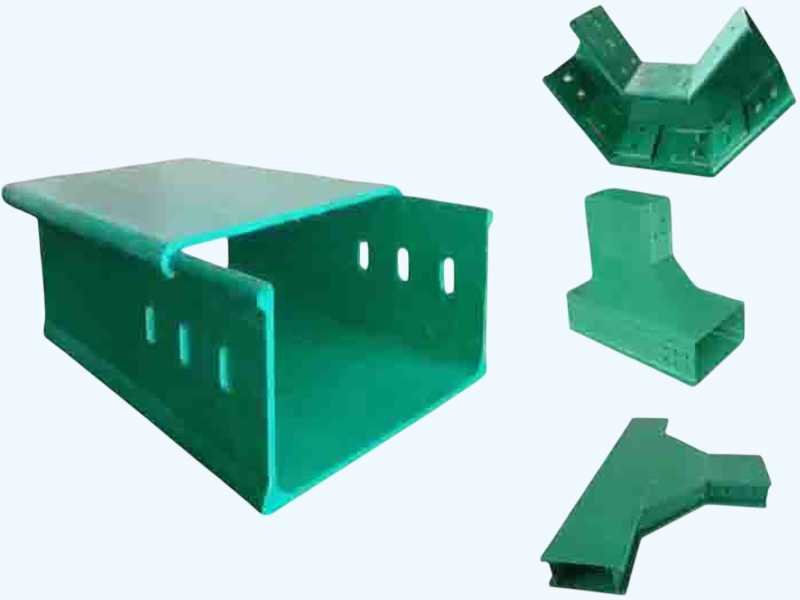
A fiberglass reinforced plastic cable tray serves as a non-metallic alternative to conventional steel cable management systems exposed to moisture, chemical agents, salt mist, and aggressive industrial atmospheres. Containing no metallic conductive pathway within the composite structure, FRP cable trays provide inherent non-conductive characteristics. Chemical resistance performance is commonly evaluated according to ASTM D543.
FRP cable trays are manufactured in multiple configurations including ladder type, trough type, and perforated tray systems. Structural performance depends on tray geometry, span length, reinforcement architecture, and installation conditions. Composite mechanical characteristics may be evaluated through testing methods including ASTM D790.
For applications requiring fire performance, FRP cable tray systems can incorporate flame-retardant resin formulations. Fire characteristics may be evaluated according to ASTM E84, with applicable requirements depending on project specifications. Typical operating temperatures range from −40 °C to 80 °C, depending on resin selection and environmental conditions.
Resin Selection
| Service Environment | Typical Resin Selection |
|---|---|
| General Industrial Environment | Isophthalic Polyester Resin |
| Wastewater Treatment Applications | Isophthalic Polyester / Vinyl Ester Resin |
| Marine and Coastal Exposure | Vinyl Ester Resin |
| Chemical Processing Facilities | Vinyl Ester Resin |
| High H₂S / Sulphur Recovery Areas | Vinyl Ester Resin |
| Fire Performance Requirements | Brominated Flame-Retardant Resin System |
The table above provides general guidance for preliminary resin selection based on common industrial service environments. Actual resin selection should consider specific chemical concentrations, exposure duration, operating temperature, UV exposure, and mechanical load requirements. Final material specification should be confirmed through chemical compatibility verification with the manufacturer. For applications involving mixed chemical streams or fluctuating process conditions, consult the manufacturer's technical desk for detailed compatibility assessment.
Engineering Specifications
| Parameter | Typical Value |
|---|---|
| Product Type | FRP non-metallic cable tray system |
| Configurations | Ladder tray, trough tray, perforated tray |
| Common Widths | 150 mm, 300 mm, 450 mm, 600 mm |
| Side Rail Height | 100 mm or 150 mm |
| Load Classification | NEMA Class A, B, or C depending on configuration and design requirements |
| Standard Length Options | 3 m and 6 m sections; project-specific lengths available |
| Typical Weight | Approximately 4–10 kg/m depending on configuration |
| Fire Performance | Flame spread index ≤25 when tested per ASTM E84 |
| Chemical Resistance | Evaluated according to ASTM D543 chemical resistance testing |
| Moisture Absorption | Evaluated through composite testing methods such as ASTM D570 |
| Service Temperature | Approximately −40 °C to 80 °C depending on resin system |
| Splice Hardware | 316 stainless steel splice plates and hardware |
| Applicable Standards | NEMA VE-1, ASTM E84, ASTM D543 |
The values listed represent typical ranges for pultruded FRP cable tray systems manufactured with isophthalic polyester or vinyl ester resin systems. Actual values for a specific tray configuration depend on profile geometry, fiber architecture, resin formulation, and manufacturing conditions. For project-specific engineering data including load-deflection curves, span tables, and chemical compatibility reports, contact the manufacturer with your installation parameters.
Proven in Field
"FRP cable tray systems are applied in chemical processing facilities, wastewater treatment plants, offshore platforms, and coastal industrial environments where corrosion resistance, electrical isolation, and reduced maintenance requirements are important engineering considerations."
— Industrial Cable Management Application Experience
Review Technical Specifications & Cable Tray Profiles
WayTong manufactures FRP cable trays in ladder, trough, and perforated configurations with engineering support for load classification review, span evaluation, resin selection, chemical compatibility assessment, and project-specific cable management requirements.
Request Product InformationThis FRP cable tray system is part of the WayTong FRP Access Components portfolio, which also includes FRP ladders, FRP handrails, and related non-metallic industrial infrastructure systems. For complete empirical performance references, see the ASTM Standards Summary.