
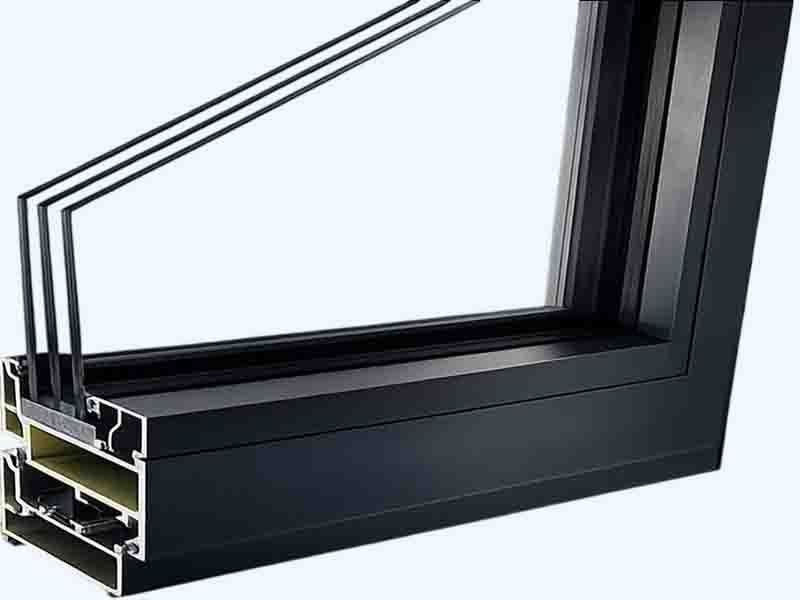
A thermal break window frame built from pultruded PU-GRP sections addresses the fundamental trade‑off that architectural fenestration has contended with for decades: maintaining slim sightlines and high structural loads while meeting the severe U‑value thresholds in ASHRAE 90.1 or LEED v4. Traditional aluminum profiles require extensive mechanical thermal breaks that can compromise structural integrity. In contrast, a polyurethane window extrusion utilizes a high‑density fiberglass reinforcement matrix bound by a low‑conductivity polyurethane resin core. Thermal conductivity typically ranges between 0.15–0.30 W/m·K when tested per ASTM C518. Equivalent international methods may include EN 12667. The resulting monolithic composite frame commonly achieves frame U‑values of 0.8–1.2 W/m²·K, depending on glazing interface and spacer selection, without requiring internal steel or aluminum reinforcements.
On the structural side, these composite sections typically provide dimensional stability under varying climate loads. The cross‑linked polyurethane matrix distributes structural loads uniformly across the fiber network, resisting the torsional and bending moments that heavy triple‑glazed casement or tilt‑and‑turn architectural windows experience under wind pressure. Longitudinal tensile strength typically ranges between 700–1,100 MPa when tested in accordance with ASTM D638, with actual values depending on fiber architecture and profile cross‑section. This helps keep frame corners tight and maintains optimal air‑barrier gasket compression over extended service periods. Because the thermal expansion coefficient closely matches concrete and glass, the risk of perimeter sealant failure is generally reduced. The profile engineering incorporates standard Euro‑groove geometries, allowing seamless integration of multi‑point commercial locking hardware and concealed hinges without workshop tooling reconfigurations. Flexural modulus typically ranges between 40–55 GPa, providing the stiffness required for large‑format fenestration elements.
Profiles are available in standard frame depths of 55, 65, 75, and 85 mm. Surface finish is a UV‑stabilized multi‑coat polyurethane system, available in custom RAL colors. Flame spread index is generally ≤ 25 when tested per ASTM E‑84; Euroclass C‑s1,d0 self‑extinguishing classification is available. Fabrication follows standard composite miter‑cutting and heavy‑duty mechanical corner joining workflows.
Proven in Field
"Our mid‑rise commercial retrofit needed to bring the fenestration system down from a U‑value of 2.8 to below 1.2 to achieve compliance. We selected PU composite window profiles to replace the damaged aluminum units. The new frame layouts achieved 0.92 W/m²·K while completely eliminating condensation risks at the frame profile interior. The first-year post‑occupancy evaluation verified a 22% drop in HVAC zone energy consumption."
— Commercial Façade Retrofit Study
Review Frame Specifications & Thermal Performance Data
WayTong supplies PU composite window profiles in standard frame depths from 55 mm to 85 mm with custom RAL color options. Contact our technical desk for project‑specific U‑value calculations, wind‑load certification, and hardware compatibility verification.
Request Technical InformationThese frame profiles integrate into the broader WayTong PU Composite Profiles family—including door sub‑frames and structural thermal break blocks. For complete thermal and mechanical performance data, see the ASTM Standards Summary.