
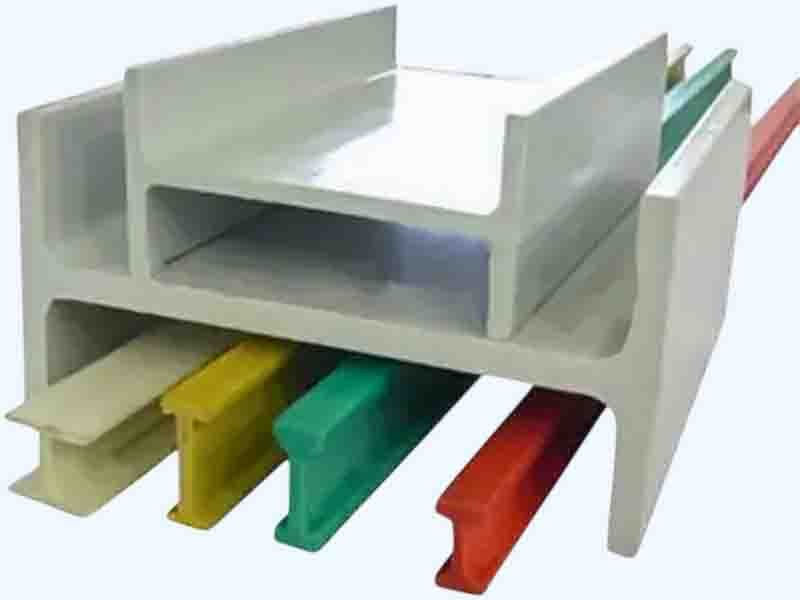
Direct dimensional replacement for steel I‑sections. The flange widths, web depths, and overall geometry follow standard steel I‑beam conventions—W4, W6, W8, and W10 profiles are commonly available. This means an engineer specifying FRP generally does not need to redesign the connection details from scratch. Bolt holes, splice plates, and bearing seats all follow familiar dimensional logic. Standard flange widths typically range from 100 mm to 250 mm, with web depths in the same range for longer spans. Wider flanges are available for higher lateral stability.
Weight that changes the installation equation. At roughly one‑quarter the weight of an equivalent steel section, a 6‑metre FRP I‑beam can be carried by two people without lifting equipment. On a congested chemical plant mezzanine or an offshore platform with crane access limitations, that weight difference determines whether the job takes a morning or a full shift with a rigging crew. Weight typically ranges from 6–15 kg/m, depending on profile size.
Non‑conductive, non‑magnetic. For substation structures, MRI facility framing, and aluminium smelter walkways, the fact that FRP carries no electrical current and generates no magnetic interference is often the primary reason it is specified. Steel generally cannot compete in these applications without elaborate isolation measures.
Corrosion resistance without coating maintenance. In a chemical plant or coastal marine environment, a painted steel I‑beam is on a maintenance clock from the day it's installed. FRP I‑beams in vinyl ester resin can largely eliminate that cycle—no blasting, no priming, no topcoat required. The upfront material cost may be higher, but the lifecycle arithmetic tends to close that gap within the first maintenance interval. Corrosion resistance is commonly verified under ASTM D543.
Typical structural applications where FRP I‑beams serve as primary load‑bearing elements include chemical plant pipe support bents, pedestrian bridge primary stringers, offshore platform equipment support frames, cooling tower structural members, and storage tank dike access platforms. Each of these shares a common requirement: carry bending loads reliably for decades in an environment that would consume steel in years. For related corrosion‑resistant structural solutions, see FRP Corrosion Prevention Solutions and FRP Structural Support Applications.
Flexural modulus commonly ranges between 18–28 GPa, depending on fibre architecture and resin system. Length is typically up to 6 m, with longer lengths available on request. Resin options include isophthalic polyester as standard, with vinyl ester available for aggressive chemical or marine environments. Maximum continuous service temperature is typically 80 °C for polyester and 100 °C for vinyl ester, with short‑term excursions acceptable. Surface finish is smooth as standard, with grit or UV veil available on request. The unidirectional fibre architecture of pultruded FRP composites provides the high longitudinal stiffness required for primary flexural members in corrosive atmospheres.
Standard Dimensional Parameters
Commonly available sectional dimensions and standard stock lengths for pultruded FRP I‑beams are listed below for reference. Custom cross‑sections, heavier wall sections, and project‑specific tolerances are available on request.
| Parameter | Commonly Available Specification |
|---|---|
| I‑Beam — Small (H × B × t) | 50×30×5 mm, 76×38×5 mm, 80×40×5 mm |
| I‑Beam — Medium (H × B × t) | 100×50×6 mm, 100×60×6 mm, 120×60×6 mm, 120×60×8 mm, 150×75×6 mm, 150×75×8 mm |
| I‑Beam — Large (H × B × t) | 200×100×8 mm, 200×100×10 mm, 250×125×10 mm, 300×150×10 mm, 300×150×12 mm |
| Standard Stock Length | 3 m, 6 m |
Additional web depths up to 300 mm and flange widths up to 150 mm are available for custom orders. For section modulus data, moment of inertia values, and load‑span tables, see the referenced flexural modulus and ASTM performance figures above.
Proven in Field
"We used FRP I‑beams to frame the entire pipe support structure above our acid dosing area. The steel beams they replaced had corroded to the point of section loss within four years. The FRP structure has been up for over seven years now—no coating, no corrosion, no reported deflection issues."
— Structural Engineer, Water Treatment Chemical Facility
Review I‑Beam Specifications & Section Properties
WayTong supplies pultruded FRP I‑beams in standard W4 to W10 profiles with custom lengths, resin formulations, and surface finishes. Contact our technical desk for section modulus data, load‑span tables, and project‑specific substitution support.
Request Technical InformationFRP I‑beams are part of the WayTong FRP Structural Profiles range, which also includes square tubes, round tubes, angles, channels, solid rods, and flat bars. For complete mechanical and corrosion performance data, see the ASTM Standards Summary.