
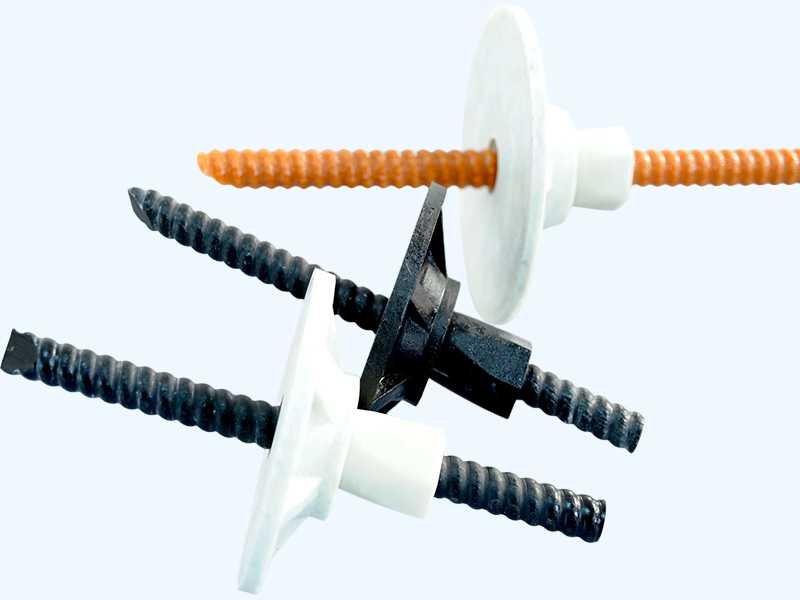
A fiberglass rock bolt carries its primary advantage into the tunnel before the first round is drilled: it can be cut by the continuous miner or roadheader without sparking, without generating a methane‑ignition hazard, and without damaging the cutter picks. That cut‑table property is what makes GFRP ground anchor systems a widely adopted temporary support in soft‑ground mechanized mining. The bolt is installed to stabilize the excavation face, the machine cuts through the reinforced ground on the next advance, and the cycle repeats without a separate bolt‑removal step. For a tunnel contractor, eliminating that step compresses the advance cycle by measurable minutes per round, which compounds over a kilometre of tunnel.
On the corrosion side, composite rock reinforcement addresses the durability gap that steel bolts leave in aggressive groundwater. A steel rock bolt in an acid‑mine‑drainage zone typically loses cross‑section from the day it is grouted; an FRP bolt, with a vinyl ester or epoxy matrix, is generally resistant to the same environment. The tensile capacity stays with the bolt for the full design life, whether that means a few months of temporary face support or permanent anchoring in a cut‑and‑cover station. Longitudinal tensile strength typically ranges between 600–1,200 MPa when tested in accordance with ASTM D7205, with actual values depending on bar diameter and manufacturing process. Modulus of elasticity typically ranges between 40–65 GPa. The non‑conductive, non‑magnetic properties also make FRP bolts the preferred anchor for MRI chambers, transformer vaults, and other electromagnetic‑sensitive installations where a metal bolt would create a ground‑loop hazard or image distortion.
Bolts are available in standard diameters of 20, 25, 32, and 38 mm, supplied in lengths from 1.2 m to 6 m, with threaded ends and matching FRP nuts and bearing plates. The thread is roll‑formed into the bar during pultrusion, so there is no machined‑in weak point. Density typically ranges between 1.9–2.2 g/cm³, approximately one‑quarter of steel. Installation follows the same grout‑and‑tension sequence as steel rock bolts, using polyester or cementitious resin cartridges. Corrosion resistance is commonly evaluated under ASTM D543. Resin systems include vinyl ester as standard, with epoxy available for high‑temperature or chemical resistance applications. For related ground support and corrosion‑resistant anchoring solutions, see FRP Corrosion Prevention Solutions and FRP Structural Support Applications.
Standard Dimensional Parameters
Commonly available bar diameters, standard lengths, and accessory specifications for pultruded FRP rock bolts are listed below for reference. Custom diameters, lengths, and project‑specific thread configurations are available on request.
| Parameter | Commonly Available Specification |
|---|---|
| Bar Diameter — Light Duty | 16 mm, 18 mm |
| Bar Diameter — Standard Duty | 20 mm, 22 mm |
| Bar Diameter — Heavy Duty | 25 mm, 28 mm |
| Bar Diameter — Extra Heavy Duty | 32 mm |
| Standard Lengths | 1.5 m, 2.0 m, 2.5 m, 3.0 m, 3.5 m, 4.0 m, 4.5 m, 5.0 m, 6.0 m |
| Thread Type | Right‑hand full‑length thread; pitch 10 mm (small diameters), 12 mm (large diameters) |
| Tensile Strength (Longitudinal) | 600–1,200 MPa per ASTM D7205 |
| Modulus of Elasticity | 40–65 GPa |
| Density | 1.9–2.2 g/cm³ |
| Bearing Plate — Square | 150×150 mm, 200×200 mm, 250×250 mm; thickness 8–12 mm; center hole matching bar diameter |
| Bearing Plate — Round | Ø 150 mm, Ø 200 mm; thickness 8–10 mm |
| Nut — Hexagonal FRP | M20, M22, M25, M28, M32; flat‑to‑flat width 36–46 mm; height 25–35 mm |
| Coupler Sleeve | Internally threaded; outer diameter greater than bar diameter; length 100–150 mm |
| Centralizer / Spacer | FRP or plastic snap‑on ring; outer diameter matching drill hole (typically 32 mm, 42 mm) |
| Resin System | Vinyl ester (standard); Epoxy (high‑temperature/chemical resistance) |
| Applicable Standards | ASTM D7205, ASTM D543; MT/T 1061 (China coal mine) |
Custom bar diameters, non‑standard lengths up to 6 m, and project‑specific thread configurations are available on request. For pull‑out capacity calculations, resin compatibility charts, and ground support design verification, see the referenced ASTM D7205 and ASTM D543 performance figures above.
Proven in Field
"We switched to FRP rock bolts for face stabilization in a 3‑kilometre soft‑ground tunnel under a groundwater aquifer. The bolts went in with standard grouting, and the roadheader cut straight through them on the next pass—no sparks, no pick damage, no separate bolt removal. Over 3,000 bolts installed, no reported corrosion‑related failures after four years of continuous groundwater exposure."
— Soft‑Ground Tunnel Face Stabilization Study
Review Bolt Specifications & Anchor Design Data
WayTong supplies FRP rock bolts in standard diameters from 20 mm to 38 mm, with lengths up to 6 m and matching FRP nuts and bearing plates. Contact our technical desk for project‑specific pull‑out calculations, resin compatibility charts, and ground support design verification.
Request Technical InformationThese rock bolts integrate into the WayTong FRP Reinforcement package alongside GFRP rebar, rebar mesh, and couplers. For complete mechanical performance data, see the ASTM Standards Summary.