
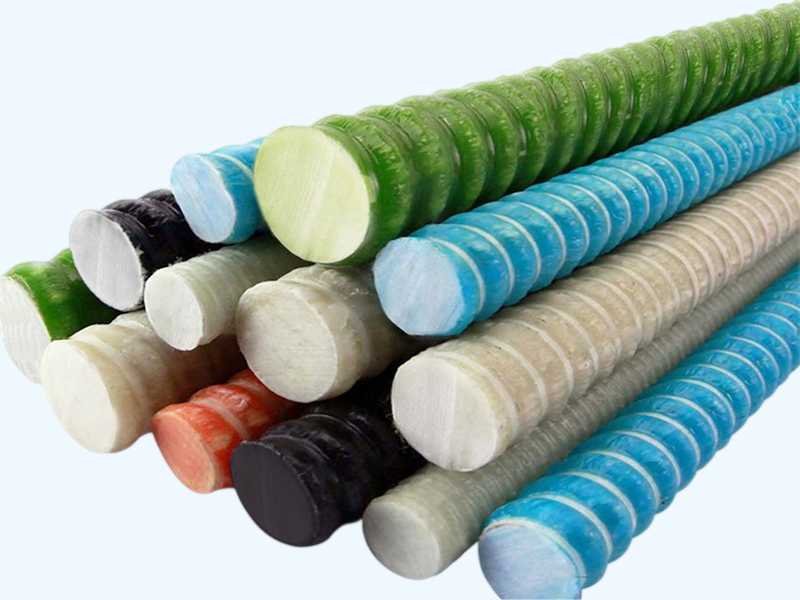
Where steel rebar corrodes, glass fiber composite rebar passes the chloride threshold test without a coating. The E‑glass or ECR‑glass fibers embedded in a vinyl ester or epoxy matrix are generally resistant to electrochemical corrosion, so there is typically no need for epoxy coatings, galvanising, or stainless‑steel alloys to achieve a long service life. In bridge decks and parking garages subject to seasonal de‑icing salts, this property helps prevent the spalling and delamination that start at the rebar mat and travel upward through the concrete cover. The result is a structure that maintains its designed concrete cover and bond strength without the periodic patching cycles that steel‑reinforced elements commonly demand. Corrosion resistance is verified per ASTM D543.
On the structural side, glass fiber reinforced polymer rebar delivers tensile strength typically ranging between 600–1,200 MPa in the longitudinal direction when tested in accordance with ASTM D7205, with actual values depending on bar diameter and resin matrix selection. Modulus of elasticity typically ranges between 40–65 GPa. Design engineers commonly follow ACI 440.1R for flexural and shear design, using a guaranteed tensile strength and a creep‑rupture stress limit for sustained loads. The bar surface is typically sand‑coated or ribbed to transfer bond stresses into the surrounding concrete. Available diameters range from 6 mm to 32 mm, covering applications from thin architectural panels to heavy mat foundations. For glass fiber rebar concrete in marine applications such as sea walls and jetties, the rebar's low magnetic permeability also makes it the specified material for MRI facilities, transformer vaults, and other electromagnetic‑sensitive structures where a steel‑free zone is mandatory.
Density typically ranges between 1.9–2.2 g/cm³, approximately one‑quarter of steel. Standard lengths are 6 m or 12 m, with custom lengths available. Bars are bundled and labelled by diameter and lot for traceability from the pultrusion line to the job site. Thermal expansion typically ranges between 6–10 × 10⁻⁶/°C longitudinally, closely matching concrete. Surface profile options include sand‑coated, helical wrap, or integrally molded ribs for bond. Resin systems include vinyl ester as standard, with epoxy available for high‑temperature curing conditions. The continuous E‑glass fiber reinforcement in pultruded GFRP composites provides the predictable tensile properties, consistent cross‑section, and long‑term alkali durability required for structural concrete reinforcement in corrosive environments. For related corrosion‑resistant reinforcement strategies, see FRP Corrosion Prevention Solutions and FRP Structural Support Applications.
Standard Dimensional Parameters
Commonly available bar diameters, standard supply lengths, and surface profile options for GFRP rebar are listed below for reference. Custom diameters, coil‑wound options for small diameters, and project‑specific cut lengths are available on request.
| Parameter | Commonly Available Specification |
|---|---|
| Bar Diameter — Light Duty | 6 mm, 8 mm |
| Bar Diameter — Standard Duty | 10 mm, 12 mm |
| Bar Diameter — Heavy Duty | 14 mm, 16 mm |
| Bar Diameter — Extra Heavy Duty | 18 mm, 20 mm, 22 mm, 25 mm |
| Bar Diameter — Special Heavy | 28 mm, 32 mm |
| Standard Lengths (Straight Bars) | 6 m, 9 m, 12 m |
| Coil Supply (Diameter ≤10 mm) | 100 m, 200 m per coil |
| Surface Profile | Sand‑coated, helical rib (deformed), or smooth |
| Tensile Strength (Longitudinal) | 600–1,200 MPa per ASTM D7205 |
| Modulus of Elasticity | 40–65 GPa |
| Density | 1.9–2.2 g/cm³ |
| Thermal Expansion (Longitudinal) | 6–10 × 10⁻⁶/°C |
| Resin System | Vinyl ester (standard); Epoxy (elevated‑temperature/high‑strength) |
Custom bar diameters up to 32 mm, non‑standard lengths, and project‑specific alkali resistance documentation are available on request. For tensile performance curves, creep‑rupture data, and ACI 440.1R design support, see the referenced ASTM D7205 and ASTM D543 performance figures above.
Proven in Field
"The bridge deck reinforced with GFRP bars showed no corrosion‑related cracking after five winters of de‑icing salt exposure. The previous steel‑reinforced deck on the same crossing required patching every two years, so the elimination of that maintenance alone offset the initial material cost."
— Bridge Deck GFRP Reinforcement Study
Review Rebar Specifications & Reinforcement Design Data
WayTong supplies GFRP rebar in standard diameters from 6 mm to 32 mm, with vinyl ester or epoxy resin systems and sand‑coated or ribbed surface profiles. Contact our technical desk for project‑specific tensile performance curves, creep‑rupture data, and ACI 440.1R design support.
Request Technical InformationGFRP rebar integrates into the WayTong FRP Reinforcement family alongside BFRP rebar, couplers, and mesh. For complete mechanical performance data, see the ASTM Standards Summary.