
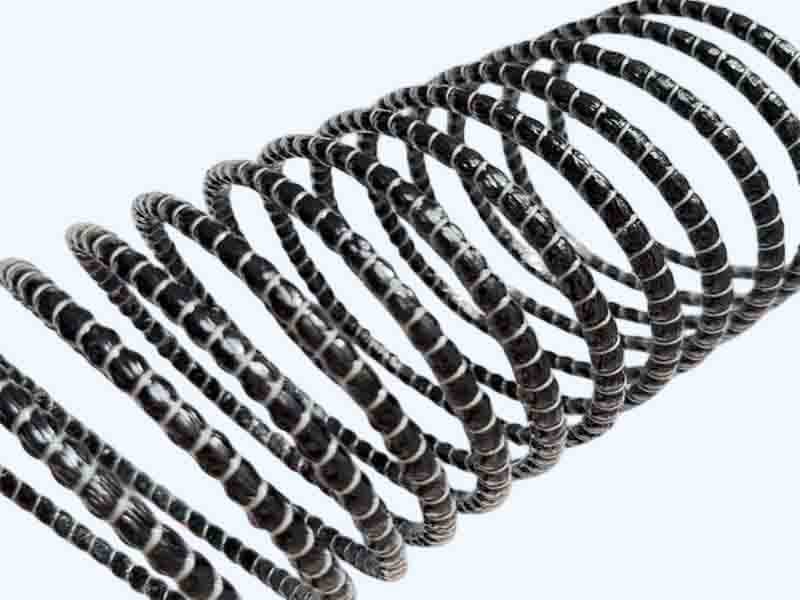
A basalt fiber composite rebar bar starts with continuous basalt roving drawn from a single‑source volcanic rock melt—no additives, no recycled glass. The fiber chemistry yields a softening point above 800°C, higher than conventional glass fiber, which directly extends the bar's service temperature. When embedded in a vinyl ester or epoxy matrix, the composite generally withstands sustained exposure to alkaline pore solutions that may degrade lower‑grade glass fibers over decades. Alkali resistance is commonly evaluated under ASTM D7705. For basalt rebar specified in geopolymer concrete or refractory slabs, this thermal buffer and alkali resistance can remove the need for additional protective coatings or increased cover depth. Corrosion resistance is commonly verified under ASTM D543.
Mechanically, basalt fiber reinforced concrete reinforcement typically matches or exceeds the tensile performance of standard glass‑based FRP bars. Tensile strength typically ranges between 600–1,200 MPa when tested in accordance with ASTM D7205, with actual values depending on bar diameter and resin matrix selection. Elastic modulus typically ranges between 40–65 GPa, at the higher end of the FRP rebar spectrum for basalt compositions. The bar surface is sand‑coated or ribbed to transfer bond stresses, and the density typically ranges between 2.0–2.2 g/cm³, keeping the bar weight at approximately one‑quarter of steel. For structures that demand a fully natural mineral fiber source on environmental or certification grounds, the mined‑basalt supply chain provides a traceable, single‑origin raw material with documented provenance.
Bars are available in standard diameters of 6, 10, 13, 16, 19, 22, and 25 mm, shipped in 6 m or 12 m lengths, bundled and labelled by diameter and production batch for full traceability from the melt to the site. Surface profile options include sand‑coated or integrally wound helical rib for bond. Resin systems include vinyl ester as standard, with epoxy available for elevated‑temperature or chemical exposure applications. Thermal expansion typically ranges between 6–8 × 10⁻⁶/°C longitudinally, closely matching concrete. The basalt fiber softening point is typically above 800°C. The continuous basalt fiber reinforcement in pultruded BFRP composites provides the high‑temperature stability and alkali durability required for long‑term structural performance in aggressive ground conditions. For related corrosion‑resistant reinforcement strategies, see FRP Corrosion Prevention Solutions and FRP Structural Support Applications.
Standard Dimensional Parameters
Commonly available bar diameters, standard supply lengths, and surface profile options for BFRP rebar are listed below for reference. Custom diameters, coil‑wound options for small diameters, and project‑specific cut lengths are available on request.
| Parameter | Commonly Available Specification |
|---|---|
| Bar Diameter — Light Duty | 6 mm, 8 mm |
| Bar Diameter — Standard Duty | 10 mm, 12 mm |
| Bar Diameter — Heavy Duty | 14 mm, 16 mm |
| Bar Diameter — Extra Heavy Duty | 18 mm, 20 mm, 22 mm, 25 mm |
| Standard Lengths (Straight Bars) | 6 m, 9 m, 12 m |
| Coil Supply (Diameter ≤10 mm) | 100 m, 200 m per coil |
| Surface Profile | Sand‑coated, helical rib (deformed), or smooth |
| Tensile Strength (Longitudinal) | 600–1,200 MPa per ASTM D7205 |
| Modulus of Elasticity | 40–65 GPa |
| Density | 2.0–2.2 g/cm³ |
| Thermal Expansion (Longitudinal) | 6–8 × 10⁻⁶/°C |
| Fiber Softening Point | > 800°C |
| Resin System | Vinyl ester (standard); Epoxy (elevated‑temperature/chemical exposure) |
Custom bar diameters up to 32 mm, non‑standard lengths, and project‑specific alkali resistance documentation are available on request. For tensile performance curves, bond strength data, and full reinforcement schedule support, see the referenced ASTM D7205, ASTM D7705, and ASTM D543 performance figures above.
Proven in Field
"The BFRP‑reinforced foundation slab in our geothermal plant has now seen five years of continuous exposure to ground temperatures above 60°C and alkaline soil water. There is no evidence of micro‑cracking or bond degradation, and the slab surface remains as placed."
— Geothermal Plant Foundation Slab Study
Review Rebar Specifications & Reinforcement Design Data
WayTong supplies BFRP rebar in standard diameters from 6 mm to 25 mm, with vinyl ester or epoxy resin systems and sand‑coated or ribbed surface profiles. Contact our technical desk for project‑specific tensile performance curves, alkali resistance documentation, and full reinforcement schedule support.
Request Technical InformationBFRP rebar integrates into the WayTong FRP Reinforcement family alongside GFRP rebar, couplers, and mesh. For complete mechanical performance data, see the ASTM Standards Summary.