
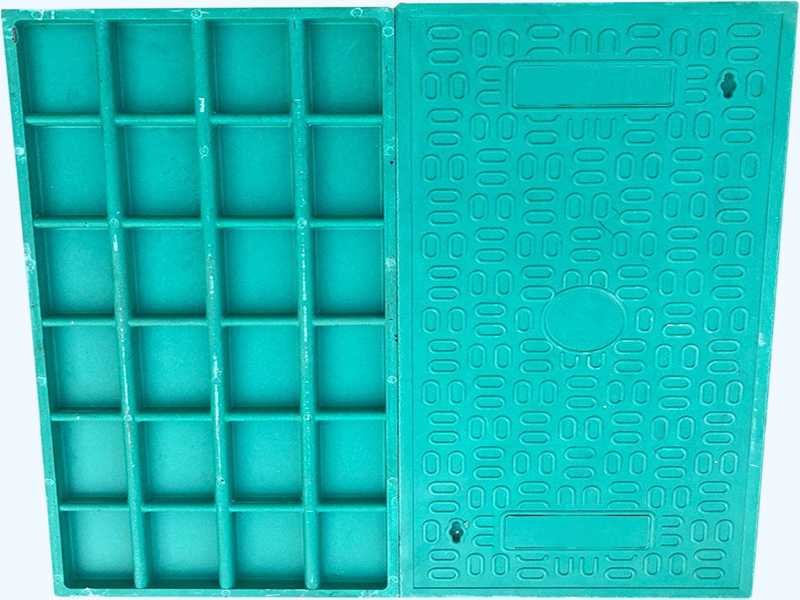
A fiberglass trench cover earns its place when access frequency and corrosion work against conventional materials. In a chlorine contact basin, steel covers typically seize against their frames within months; removing them for a routine inspection often means cutting or prying. An FRP panel generally lifts out by hand because the resin‑rich surface does not readily bond to concrete or metal seating faces. That repeatable, low‑effort access is what maintenance planners commonly notice first. When the cover doubles as FRP trench grating—with an open‑mesh surface—daylight and ventilation reach the cables below, helping keep the trench interior drier and reducing condensation‑driven corrosion on the contained services.
On the structural side, these removable trench covers are built as pultruded or molded panels with integral stiffening ribs. Load ratings typically follow EN 124 or equivalent classifications, from light‑duty pedestrian to forklift traffic, with actual load performance depending on panel thickness, span length, and support spacing. The panels can be supplied with flush‑mount stainless steel locks for public walkways, or simple drop‑in recesses for plant rooms where only operators need access. Standard widths are commonly up to 600 mm, with lengths to 3 m and custom dimensions available. Panel thickness typically ranges from 25–40 mm, depending on load class. Weight per panel commonly ranges from 15–30 kg, easily handled by two persons. Corrosion resistance is commonly verified under ASTM D543.
Resin systems include isophthalic polyester as standard, with vinyl ester available for strong chemical exposure. Surface finish options include integrally molded grit for anti‑slip performance, with UV‑stabilized gel‑coat for outdoor use. Locking options include 316 stainless steel flush bolts or recessed lift handles with padlock provision. Because the resin system matches the trench linings and channels in the rest of the WayTong FRP Infrastructure scope, there is generally no galvanic or chemical incompatibility at the cover‑to‑frame interface. Installation does not require grouting or welding. The panels drop into the prepared frame or onto a continuous angle seat; shims are rarely needed because the molded edges are uniform. For related trench access and drainage solutions, see FRP Drainage Systems and FRP Cable Management Applications.
Standard Dimensional Parameters
Commonly available panel widths, lengths, and thicknesses for molded and pultruded FRP trench covers are listed below for reference. Custom span dimensions, load‑class configurations, and surface finishes are available on request.
| Parameter | Commonly Available Specification |
|---|---|
| Cable Trench Cover — Width (Clear Span) | 200 mm, 300 mm, 400 mm, 500 mm, 600 mm, 800 mm, 1000 mm |
| Cable Trench Cover — Length | 500 mm, 600 mm, 1000 mm, 1200 mm, 1500 mm, 2000 mm |
| Cable Trench Cover — Thickness (Light Duty, A15) | 25 mm |
| Cable Trench Cover — Thickness (Standard, B125) | 30 mm |
| Cable Trench Cover — Thickness (Heavy Duty, C250) | 38 mm |
| Cable Trench Cover — Thickness (Extra Heavy, C250+) | 50 mm, 65 mm, 75 mm |
| Drainage Trench Cover — Width | 100 mm, 150 mm, 200 mm, 300 mm |
| Drainage Trench Cover — Length | 500 mm, 600 mm, 1000 mm |
| Drainage Trench Cover — Thickness | 25–40 mm |
| Load Classes (EN 124) | A15 (pedestrian/landscape), B125 (parking/light vehicle), C250 (slow‑moving truck) |
| Surface Wear Layer | Integrally bonded silica grit, 3–5 mm; molded anti‑slip pattern |
| Open‑Mesh Option | Grating panel with >30% open area for ventilation and drainage |
| Typical Panel Weight | 15–30 kg |
| Frame/Seating Option | FRP or 316 stainless steel angle frame; continuous angle seat |
Custom widths up to 1000 mm, lengths up to 3000 mm, and load ratings up to C250 are available on request. For span‑rating calculations, locking hardware specifications, and chemical compatibility data, see the referenced ASTM D543 performance figure above.
Proven in Field
"The cast‑iron trench covers over our chlorine contact basin had become a safety and maintenance issue—they seized solid each winter and took two mechanics half a shift to free. Since switching to FRP covers, a single operator lifts them for the weekly inspection. We have also eliminated the scrap‑metal theft risk that affected the remote compound."
— Chlorine Contact Basin Trench Upgrade
Discuss Your Trench Cover Project Requirements
WayTong supplies FRP trench covers in standard and custom dimensions with load ratings from light‑duty pedestrian to forklift traffic. Contact our technical desk for span‑rating calculations, locking hardware specifications, and project‑specific material recommendations.
Discuss Project RequirementsThese covers integrate into the WayTong FRP Infrastructure portfolio alongside drainage channels, manhole covers, and cable trench linings. For complete mechanical and load performance data, see the ASTM Standards Summary.