
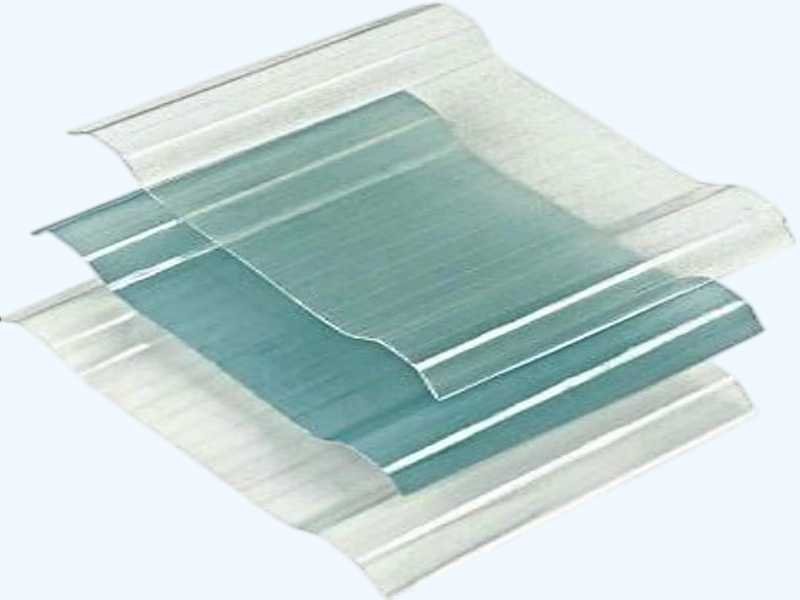
A fiberglass roofing panel serves two functions that industrial buildings rarely get from a single material: it lets in diffused daylight while keeping corrosive fumes out of the roof structure. The polyester or vinyl ester matrix is generally resistant to the acidic vapours and hydrogen sulphide that turn metal roof sheets into perforated scrap within a few operating seasons. Corrosion resistance is commonly verified under ASTM D543. At the same time, the panel's translucency—typically 60–85% light transmission depending on the pigment load, when tested per ASTM D1494—means a chemical warehouse can operate much of the day shift without artificial lighting. That combination of corrosion resistance and daylighting is why translucent FRP sheets appear in the specifications of so many process buildings, from chlorine storage to composting halls.
On the structural side, FRP corrugated roofing follows the same trapezoidal or sinusoidal profile as metal sheeting, so it laps onto standard purlin spacings and accepts the same fixings. The difference is weight: at roughly 4–6 kg/m², an FRP sheet is about half the mass of an equivalent steel sheet, which reduces the dead load on the frame and simplifies handling during installation. A single operative can typically carry a 3‑metre sheet up a ladder without assistance. The corrugations provide longitudinal stiffness for normal wind and snow loads, and the material's fatigue resistance under cyclic wind loading generally means fewer fastener‑loosening call‑backs compared to lightweight metal roofs in exposed locations.
Standard sheet dimensions are 1.1 m wide × 3 m or 6 m long, with cut‑to‑length options available. Thickness typically ranges from 1.2–3.0 mm, depending on span and load requirements. Resin systems include isophthalic polyester with UV‑stabilized surface veil as standard, with vinyl ester available for aggressive chemical atmospheres. Service temperatures typically range from −40°C to 100°C continuous, depending on resin selection. Fire‑retardant grades are available, with flame spread index generally ≤ 25 when tested per ASTM E‑84. Equivalent international classifications may include BS 476 Class 1. Installation uses standard self‑drilling fasteners with EPDM sealing washers through the crown of the corrugation. Side laps and end laps follow the same minimum overlap as metal roofing—typically 1.5 corrugations and 150 mm respectively—so the panel integrates into a hybrid roof without custom flashings. For related corrosion‑resistant building envelope solutions, see FRP Corrosion Prevention Solutions and FRP Structural Support Applications.
Standard Profile and Dimensional Parameters
Commonly available corrugated profile types and standard sheet dimensions for FRP roofing panels are listed below for reference. Custom profile geometries, sheet lengths, and pigmentation levels are available for project‑specific architectural and structural requirements.
| Parameter | Commonly Available Specification |
|---|---|
| Profile Type — 840 (Trapezoidal) | Effective cover width 840 mm; expanded width approx. 1000 mm; wave height 25 mm; wave pitch 210 mm (4 crests) |
| Profile Type — 900 (Shallow Sine) | Effective cover width 900 mm; expanded width approx. 1100 mm; wave height 15–18 mm; wave pitch 225 mm (4 crests) |
| Profile Type — 950 (Deep Sine) | Effective cover width 950 mm; expanded width approx. 1200 mm; wave height 35–50 mm; wave pitch 250 mm (3–4 crests) |
| Profile Type — 1050/1100 (High‑Wave) | Effective cover width 1050 mm or 1100 mm; expanded width approx. 1250–1300 mm; wave height 50–70 mm |
| Profile Type — T‑820/T‑750 (Trapezoidal Lock‑Seam) | Effective cover width 820 mm or 750 mm; wave height 30–40 mm |
| Thickness — Light Duty | 1.2 mm |
| Thickness — Standard Duty | 1.5 mm |
| Thickness — Heavy Duty | 2.0 mm |
| Thickness — Extra Heavy Duty | 2.5 mm, 3.0 mm |
| Standard Sheet Length | 3 m, 6 m; custom up to 12 m |
| Light Transmission (Clear) | 80–85% per ASTM D1494 |
| Light Transmission (Translucent/Tinted) | 60–70% per ASTM D1494 |
| Weight per Unit Area | 4–6 kg/m² |
Additional profile geometries, custom sheet lengths, and specific fire‑retardant or chemical‑resistant resin formulations are available on request. For wind‑load tables, purlin spacing recommendations, and light transmission test reports, see the referenced ASTM D1494 and ASTM E‑84 performance figures above.
Proven in Field
"The metal roof over our chemical storage shed had rusted through in less than four years from chlorine dioxide fumes. We replaced it with FRP roofing sheets and saw an immediate improvement—the building interior now has natural daylight, and after three years there is no visible corrosion on the panels or fasteners."
— Chemical Storage Roof Replacement
Discuss Your Roofing Project Requirements
WayTong supplies FRP roofing sheets in standard profiles and sheet sizes with clear or tinted translucency options and fire‑retardant resin grades. Contact our technical desk for wind‑load calculations, purlin spacing recommendations, and project‑specific material specifications.
Discuss Project RequirementsThese roofing sheets integrate into the WayTong FRP Infrastructure portfolio alongside drainage channels, trench covers, and sound barriers. For complete mechanical and fire performance data, see the ASTM Standards Summary.