
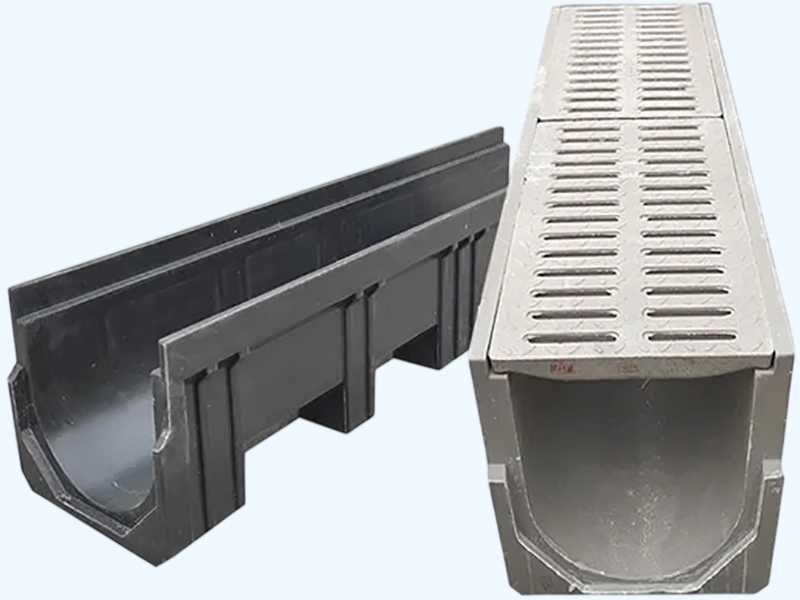
In a plating line or chemical bund, a fiberglass drainage channel does more than move liquid from point A to point B. It addresses the containment risk that corroded metal or spalled concrete introduces. The monolithic, joint‑free body removes potential leak paths at seams, and the integrally molded grating or slotted cover allows direct access for washdown. Because the resin is the same throughout, there is typically no coating to chip or reapply. For a FRP trench drain carrying mixed acids at elevated temperature, the channel generally stays dimensionally stable and resistant to chemical attack. Corrosion resistance is commonly verified under ASTM D543.
Hydraulic efficiency is built into the profile. The gel‑coat interior consistently measures a Manning's n around 0.009–0.010—comparable to new steel, but one that typically stays constant because the surface does not corrode or roughen. Engineers sizing corrosion resistant drainage for a chemical storage area often find they can specify a shallower, narrower channel than with concrete, saving on excavation and civil works. That shallow‑profile advantage also simplifies tie‑in to existing FRP infrastructure such as trench covers and sumps.
Standard internal widths include 150, 200, and 300 mm, with internal depths from 200–600 mm and custom depths available. Wall thickness is typically uniform at 5–8 mm throughout. Resin systems include isophthalic polyester as standard, with vinyl ester available for strong acids and solvents. Chemical resistance commonly spans pH 1–14 for vinyl ester grades and pH 3–10 for polyester. Service temperatures typically range from −40°C to 100°C continuous for vinyl ester, and −40°C to 80°C for polyester, depending on resin selection. Grating covers are available as molded FRP grating, slotted or solid top, with load classes per EN 1433. Channels are pre‑sloped in the factory, so the installation crew sets them at grade with minimal on‑site alignment. 316 stainless steel anchor brackets secure the channel to the concrete subfloor, and sections connect with a tongue‑and‑groove joint that seals with a single bead of chemically compatible adhesive. For related drainage and water management solutions, see FRP Drainage Systems and FRP Drainage Applications.
Standard Dimensional Parameters
Commonly available channel cross‑sections, wall thicknesses, and standard section lengths for pultruded and molded FRP drainage channels are listed below for reference. Custom widths, depths, and project‑specific hydraulic profiles are available on request.
| Parameter | Commonly Available Specification |
|---|---|
| Channel — Extra Small (Internal Width) | 100 mm |
| Channel — Small (Internal Width) | 150 mm |
| Channel — Medium (Internal Width) | 200 mm |
| Channel — Large (Internal Width) | 300 mm |
| Channel — Extra Large (Internal Width) | 400 mm, 500 mm |
| Internal Depth Range | 150 mm, 200 mm, 250 mm, 300 mm, 350 mm, 400 mm, 500 mm, 600 mm; custom available |
| Wall Thickness — Light Duty | 3–4 mm |
| Wall Thickness — Standard Duty | 5–6 mm |
| Wall Thickness — Heavy Duty | 8 mm |
| Standard Section Length | 1 m, 3 m, 6 m |
| Manning's n (Hydraulic Roughness) | 0.009–0.010 |
| Grating Cover — Load Classes (EN 1433) | A15 (pedestrian), B125 (light vehicle), C250 (truck), D400 (heavy vehicle) |
| Grating Cover — Thickness | 25–50 mm, depending on load class |
| Grating Cover — Open Area | >30% for grating covers |
| End Cap / Stop End | Matching channel cross‑section; wall thickness equal to or greater than channel body |
| Joint Type | Tongue‑and‑groove with chemically compatible adhesive seal |
| Anchor Bracket | 316 stainless steel; secures channel to concrete subfloor |
Custom channel widths up to 500 mm, depths beyond 600 mm, and project‑specific load‑class configurations are available on request. For hydraulic sizing calculations, chemical compatibility verification, and EN 1433 load‑class documentation, see the referenced ASTM D543 performance figure above and the ASTM Standards Summary.
Proven in Field
"The concrete trench drains in our nickel plating line were spalling within two years from sulphuric acid exposure. We replaced them with FRP channels of the same cross‑section. Four years later, the effluent flows at the original gradient, and there is no measurable wall loss."
— Plating Line Drainage Retrofit
Discuss Your Drainage Channel Project Requirements
WayTong supplies FRP drainage channels in standard widths from 150 mm to 300 mm with custom depths, resin formulations, and grating cover options. Contact our technical desk for hydraulic sizing, chemical compatibility verification, and project‑specific installation guidance.
Discuss Project RequirementsThese channels integrate into the WayTong FRP Infrastructure portfolio alongside trench covers, manhole covers, and sumps. For complete hydraulic and chemical resistance data, see the ASTM Standards Summary.