
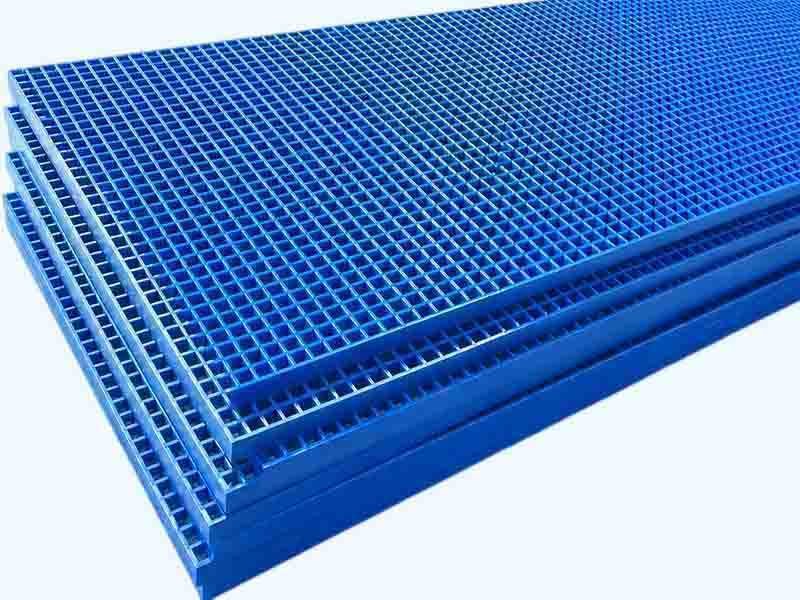
Corrosion resistance built into the resin, not the coating. With vinyl ester or polyester formulations, the entire panel generally resists sulfuric acid, sodium hydroxide, and aggressive salt sprays. There is no galvanizing to wear off—the protection is structural. Corrosion resistance is commonly verified under ASTM D543.
Bidirectional strength without extra framing. The square mesh pattern distributes loads evenly in both directions. In walkway and platform applications, fewer support beams are often needed compared to pultruded grating, which can reduce installed cost. Standard mesh size is 38 mm × 38 mm, with 50 mm × 50 mm available.
Grit‑top surface as standard. A molded‑in silica grit layer provides a slip‑resistant walking surface that does not rely on removable inserts. It typically stays effective even when the floor is wet with oil or chemical residue.
Low maintenance, predictable life. No painting, no rust scaling, no replacing corroded bars. Panels in continuous acid service commonly perform for extended periods with minimal intervention.
Typical installations include electro‑winning tankhouse floors with constant sulfuric acid mist exposure, plating shop walkways handling chromic and nitric acid rinse water, petrochemical sump covers exposed to H₂S and hydrocarbon condensate, pickle line platforms at elevated hydrochloric acid temperatures, and chemical storage area flooring in spill containment zones with mixed acids. In all these settings, molded grating replaces steel bar grating that would need replacement every 1–2 years. The avoided downtime alone commonly justifies the material cost.
Panel thickness typically ranges from 25 mm to 50 mm, with thicker panels for higher loads or longer spans. Resin options include isophthalic polyester as standard, with vinyl ester available for strong acids and alkalis, and phenolic for high‑heat and low‑smoke applications. Maximum continuous service temperature is typically 80°C for polyester, 100°C for vinyl ester, and 150°C for phenolic, with short‑term excursions acceptable. Slip resistance is achieved via an integral grit layer. Fire rating is typically ASTM E‑84 Class 1 with flame‑retardant resin, depending on resin choice.
Proven in Field
"Our tankhouse walkways were chewing through galvanized grating in 18 months. The molded FRP panels we installed six years ago still show no visible degradation—and the anti‑slip surface remains effective."
— Maintenance Engineer, Copper Refinery
Discuss Your Molded Grating Requirements
WayTong supplies molded FRP grating in standard panel sizes with custom resin formulations, mesh configurations, and surface finishes. Contact our technical desk for chemical resistance charts, load‑span tables, and project‑specific engineering support.
Discuss Project RequirementsMolded grating is part of the WayTong FRP Grating range, which also includes pultruded, mini‑mesh, covered, heavy‑duty, and phenolic grating options. For complete mechanical and corrosion performance data, see the ASTM Standards Summary.