
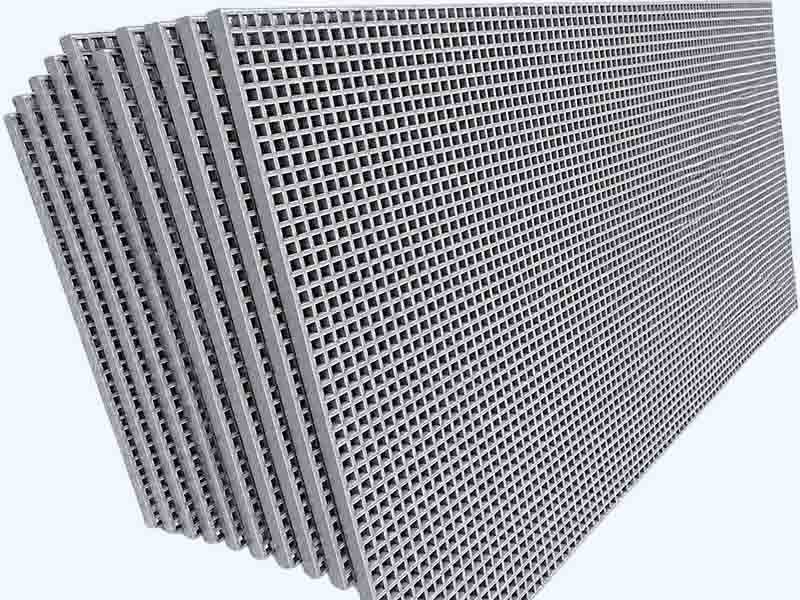
Heel‑proof by design. The 20 mm × 20 mm square opening is small enough that a stiletto heel, a cane tip, or a child's shoe generally will not punch through. For public infrastructure—pier boardwalks, aquarium viewing platforms, municipal water treatment catwalks—this single detail removes a liability that standard 38 mm grating cannot address.
Drainage without the hazard. Water, rain, and washdown spray still pass straight through. The open area is smaller than standard molded grating, yet it remains more than adequate for surface drainage. Dropped keys, phones, and small tools typically stay on the walking surface instead of disappearing into the sump below.
Wheelchair and trolley friendly. The flat, fine‑grid surface rolls smoothly. Maintenance crews pushing tool carts, visitors in wheelchairs, or families with strollers all cross without bumps or hesitation. Accessibility compliance in public‑facing facilities often makes mini‑mesh the only grating that passes review.
Same corrosion backbone. The resin options are identical to standard molded grating—polyester for general outdoor exposure, vinyl ester where chlorine or chemical mist is present. The smaller grid does not compromise chemical resistance; it is the same thermosetting resin matrix, formed around a finer mandrel set. Corrosion resistance is commonly verified under ASTM D543.
Common installations include public aquarium walkways, coastal pier decking, theme park bridge crossings, and water treatment plant catwalks—anywhere the public or unescorted personnel walk over open water or chemical baths. In these settings, the 20 mm grid is often written into the safety specification.
Standard panel thickness ranges from 25 mm to 38 mm, suited for pedestrian loads. Panel dimensions are typically up to 1.2 m × 3.6 m, with custom sizes available. Resin options include isophthalic polyester as standard, with vinyl ester available for chlorine or chemical mist environments. Load performance generally depends on span length and support spacing, with panels designed for pedestrian live loads. Maximum continuous service temperature is typically 80°C for polyester and 100°C for vinyl ester, with short‑term excursions acceptable. Surface finish is grit top as standard for slip resistance, with smooth finish available on request.
Proven in Field
"The public walkway over our treatment channels used to be steel grating with anti‑slip paint—constant repainting, constant complaints about heels getting stuck. We switched to mini‑mesh FRP three years ago. No repainting, no reported heel incidents, and the visitors' feedback has been entirely positive."
— Facilities Manager, Municipal Water Treatment Authority
Discuss Your Mini‑Mesh Grating Requirements
WayTong supplies mini‑mesh FRP grating in standard panel sizes with heel‑proof 20 mm grid, custom resin formulations, and surface finishes. Contact our technical desk for load‑span tables, accessibility compliance documentation, and project‑specific safety specifications.
Discuss Project RequirementsMini‑mesh grating is part of the WayTong FRP Grating range, which also includes standard molded, pultruded, covered, and heavy‑duty grating options. For complete mechanical and corrosion performance data, see the ASTM Standards Summary.