
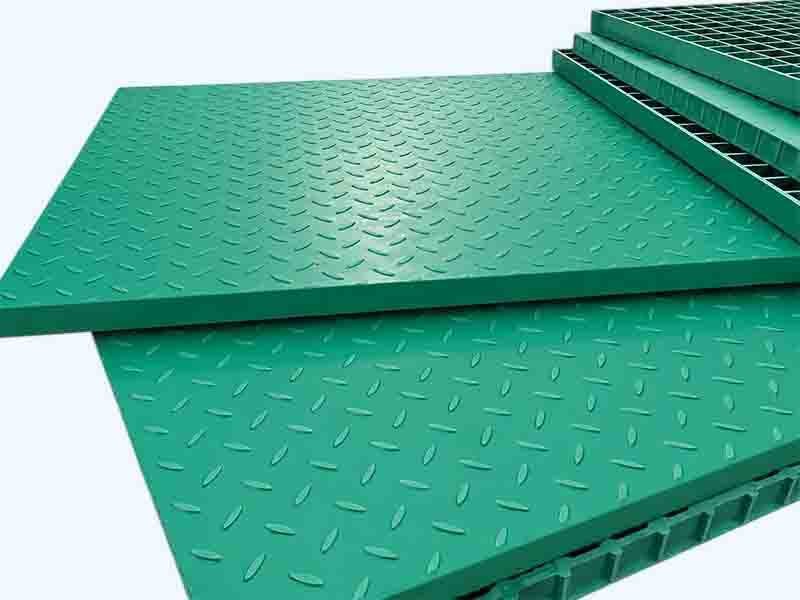
Spills stay above the floor. In a chemical storage area or battery charging station, a single acid leak can cascade if it drips through open grating onto equipment or walkways below. The solid FRP top plate acts as a sealed deck—any spill pools on the surface where it can be contained and neutralised, rather than migrating to the level beneath.
Debris and contaminants don't fall through. Clean manufacturing and food processing environments have strict hygiene protocols. Open mesh grating lets dust, product fragments, and washdown water pass to the subfloor—creating a secondary cleaning problem. A covered surface generally eliminates that pass‑through entirely while still providing the corrosion resistance of FRP underneath.
Same structural panel, cleaner surface. The underlying grating panel provides the load‑bearing capacity; the solid top sheet provides the seal. You get the bidirectional strength of molded FRP grating with a smooth or grit‑textured upper face that can be hosed down in minutes. Standard top plate thickness ranges from 3 mm to 6 mm, with thicker plates for heavier point loads. The grating substrate is typically molded FRP at 25 mm to 50 mm depth.
Corrosion resistance where both sides matter. The solid top faces the spill risk, but the open grating beneath is still exposed to whatever fumes or humidity live in the subfloor space. Vinyl ester resin throughout both components generally handles this—no differential corrosion between top sheet and grating structure. Corrosion resistance is commonly verified under ASTM D543.
Common installations include battery storage room flooring, chemical drum storage platforms, food processing mezzanines, pharmaceutical cleanroom walkways, and secondary containment decks over tank farms. In each case, the covered design addresses the same question: what happens when something spills?
Standard panel dimensions are up to 1.2 m × 3.6 m, with custom sizes available on request. Surface finish options include grit top as standard for slip resistance, with smooth finish available for food‑grade areas where squeegee cleaning is required. Resin options include isophthalic polyester as standard, with vinyl ester available for acid spill and chemical storage areas. Maximum continuous service temperature is typically 80°C for polyester and 100°C for vinyl ester, with short‑term excursions acceptable. Vinyl ester resin generally resists a broad range of chemicals including sulfuric, hydrochloric, and nitric acids; a full chemical resistance chart is available on request.
Proven in Field
"Our battery charging station floor used to be open grating over the cable basement. One acid spill and you'd have corrosion on the cable trays below. We installed covered FRP panels four years ago—spills now get neutralised on the spot, and the subfloor equipment stays dry."
— Electrical Superintendent, Industrial Manufacturing Plant
Discuss Your Containment Grating Requirements
WayTong supplies covered FRP grating in standard panel sizes with custom top plate thicknesses, resin formulations, and surface finishes. Contact our technical desk for chemical resistance charts, load‑span tables, and project‑specific containment specifications.
Discuss Project RequirementsCovered grating is part of the WayTong FRP Grating range, which also includes standard molded, pultruded, mini‑mesh, and heavy‑duty grating options. For complete mechanical and corrosion performance data, see the ASTM Standards Summary.